hat Inefficient Onboarding Is Costing Growing Franchise Brands
Onboarding is not paperwork. It is the ramp to a franchisee’s first sale — and your first royalty.
A franchisor asked me last month why two franchisees who signed in the same week were performing so differently half a year later. The answer was in their first ten days.
One was trading inside a fortnight. The other was still waiting on logins, brand assets and sign-offs six weeks in. That head start never got handed back. By month six it had compounded into a gap neither of them could quite explain — but the onboarding could.
Six months is long enough for that early gap to look like a talent gap, or a territory gap, or bad luck. It is usually none of those. It is the first two weeks, still being paid off.
What this looks like in practice is simple: onboarding is not administration. It is the ramp to first revenue. And in franchising, the franchisor’s royalties do not start until the franchisee does.
It is tempting to treat onboarding as the end of recruitment — the deal is signed, the hard part is done. It is closer to the opposite. The signature is the moment a franchisee has paid, committed, and started counting the days until it was worth it. Everything before first trading is cost with no return, for both of you. The faster that period ends, the faster the investment — theirs and yours — starts paying back.
The ramp nobody measures
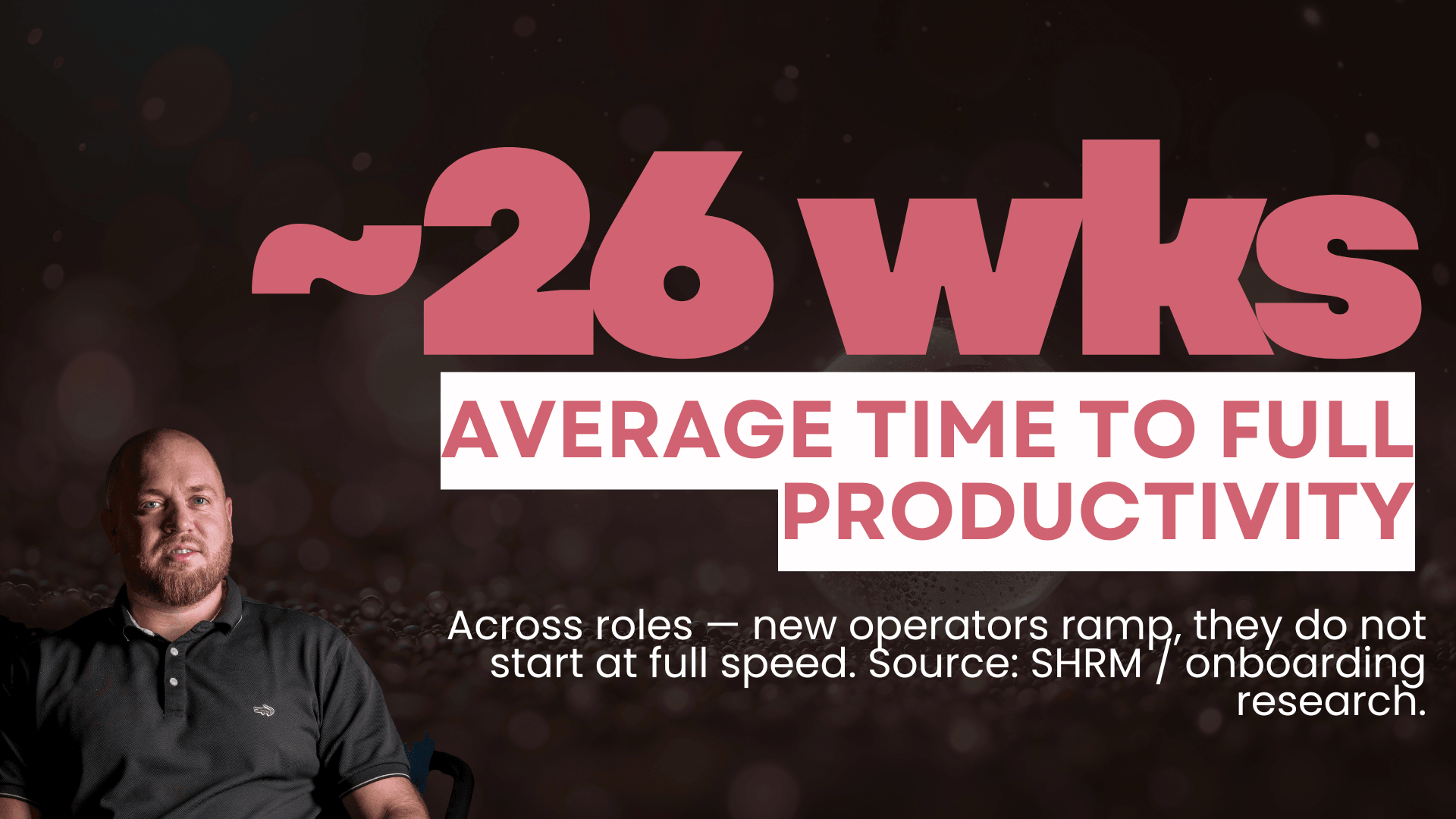
Every new hire has a ramp — the time between day one and the day they are fully productive. Across roles, that averages around 26 weeks. A franchisee is the same problem in a different costume: a ramp, not a switch you flip on signing day.
Average time to full productivity
~26 wks
Across roles — new operators ramp, they do not start at full speed. Source: SHRM / onboarding research.
Leave within 45 days
20%
When onboarding is poor. The recruitment cost walks out with them. Source: onboarding research.
The clock on a franchisee’s success starts before they have made a single sale.
Add the cash to the calendar. Onboarding a new operator typically absorbs 20 to 30% of their first-year investment in time, support and resource before they generate a pound. Drag the ramp out and that cost stretches with it — you are funding a longer runway to the same take-off. Confidence behaves the same way: a franchisee who feels in control in week one compounds that into momentum; one who feels abandoned compounds it into doubt.
What slow onboarding actually costs
Three bills land, and only one of them is obvious.
The franchisee’s delayed revenue. Every week spent onboarding instead of trading is a week of turnover that never happens. The franchisor’s delayed royalty. On a £400,000 average unit turnover at an 11.2% management fee (bfa/NatWest Franchise Survey), a month of delayed trading is a month of fees you never bill. The dropout risk. A franchisee who feels lost in week one is the one questioning the whole decision in month three.
The maths of a faster start
A franchisee trading four weeks sooner is roughly £30,000 of unit turnover pulled forward — and the management fee that rides on it earned four weeks earlier, on every new opening, every year. Multiply by your annual signings and the “admin” starts to look like a revenue lever.
| Systemised onboarding | Manual onboarding | |
|---|---|---|
| Days to first trading | ~10 days | ~6 weeks |
| First-90-day confidence | High — clear path | Low — chasing answers |
| HQ hours per franchisee | A handful | Dozens |
| Same experience every time | Yes | Depends who is free |
| Early dropout risk | Lower | Higher |
That six-weeks-to-ten-days line is not hypothetical. It is a result we have delivered — and the difference is almost entirely coordination, not teaching.
Here is the arithmetic on a single opening. Four weeks of delay on a unit that will average £400,000 a year is roughly £30,000 of trading pushed back, and — at an 11.2% management fee — a little over £3,000 of royalty you earn a month later than you needed to. On one franchisee it is an irritation. Across a year of signings it is a five-figure hole you dug with a chase-email process.
Why manual onboarding drags
Watch a manual onboarding closely and you will notice the training is the small part. The time goes on logins, document chasing, scheduling calls, resending assets, and answering the same question a different way for the fifth time.
Where manual onboarding time actually goes
Illustrative. Coordination-over-skilled-work pattern per Asana Anatomy of Work Index.
You recruited them. The first ten days decide whether that investment pays back.
The pattern is almost always the same. There is no standard sequence, so onboarding depends on who at head office happens to be free. Access is granted piecemeal, so the franchisee waits on logins to do the training that unlocks the next step. Questions get answered one email at a time, so the same twenty questions get answered forty times a year. None of it is hard. All of it is slow, because it is being coordinated by hand.
What good onboarding looks like
Good onboarding is structured, automated and identical for every franchisee — because consistency is what turns a nervous signee into a confident operator. Widely-cited onboarding research puts the prize plainly: structured onboarding is associated with materially higher retention and faster time-to-productivity than the ad-hoc version. In a franchise, that is not an HR nicety — it is the difference between a network of confident operators and a support team firefighting the same early-stage problems on repeat.
That is the job KORE by SOOM® does after the signature. A role-based franchisee view, automated access and asset delivery, and onboarding sequences that run themselves through the tools franchisees already use. Custom-built for franchise networks — so the tenth franchisee gets the same day-one experience as the first, without a single chase email from head office.
Concretely, that looks like access granted on day zero, a welcome and training sequence that triggers itself, discovery and training calls booked without a back-and-forth, and every document delivered the moment it is needed rather than the moment someone remembers. The franchisee is never waiting on head office, and head office is never chasing the franchisee. The ramp gets shorter because the friction is gone, not because anyone is working harder.
And it is identical every time. The fiftieth franchisee gets the same day-one experience as the first — same speed, same clarity, same standard — regardless of who is in the office that week. Consistency is what turns onboarding from a variable cost into a repeatable asset.
What to do this week
One number tells you everything: count the days from signature to first sale for your last five franchisees, and the hours head office spent on each. If you cannot find those numbers, that is the finding.
A good result is a signature-to-first-sale measured in days and a head-office cost measured in a handful of hours. A poor one is measured in weeks and dozens. Most franchisors have never measured either — which means the first improvement is often just making the invisible visible.
Slow onboarding is one silent tax on growth. The cost of manual reporting is another, and the full £312,000 breakdown totals them up. See how SOOM approaches franchise marketing and recruitment — first sale included, not just first signature.
Previous in this series
← Breaking Down the True Cost of Manual Franchise Reporting
Next in this series
Recruitment vs Automation: Where Should Franchisors Invest? →
SOOM® helps franchisors turn manual operations into systemised growth. Explore franchise marketing with SOOM →