Franchise Automation · May 2026
How AI Can Save a 40-Location Franchise £312,000 Per Year
By Matt · Managing Director, SOOM®
£312,000 a year on a 40-location network. Not a promise — a model, with the working shown.
£312,000. That is £7,800 per location, per year — and most of it is money a 40-unit franchise is already losing without ever seeing it on a report.
This is not a projection dressed up as a guarantee. It is a model, built from four specific leaks, with every input on the table. Change the inputs and the number changes. What does not change is that all four leaks are real, and every one of them is measurable in your own business.
Let’s make this concrete. AI does not save a franchise money by magic. It plugs four holes. Here they are, with the numbers.
One thing before the levers. Every figure below is built on a multiplier that is independently sourced — MIT, Harvard Business Review, McKinsey, Asana, the bfa/NatWest Franchise Survey. What is illustrative is the composite: a forty-unit, actively-recruiting network with a head office of a certain size. Swap in your own numbers and the total moves. The method does not.
Lever 1 — Reclaimed HQ capacity: £90,000
The admin you stop needing to hire for. As a network grows, head office usually grows with it — more people to chase numbers, rekey data and answer the same questions. The Asana Anatomy of Work Index found UK knowledge workers spend just 27% of their time on skilled work and lose 227 hours a year each to duplicated effort.
Automate the routine and you reclaim the equivalent of roughly two full-time admin roles you would otherwise add — around £90,000 a year — while cutting existing admin time by half. That is headcount you never hire, not people you remove. Most of it is the manual reporting problem, solved at source.
The arithmetic is deliberately plain. Two administrative roles you would otherwise add as the network grows, at a fully-loaded cost of around £45,000 each, is £90,000 a year you never commit to. The work does not move onto someone else’s desk — it stops being manual. Asana’s finding that only 27% of knowledge-work time is spent on skilled work is the whole opportunity: reclaim a chunk of the rest and you grow the network without growing the payroll.
Lever 2 — Recruitment revenue protected: £168,000
The leads you stop dropping. This is the biggest lever, and it is the best-evidenced. The MIT/InsideSales study found responding in five minutes rather than thirty makes you 21 times more likely to qualify a lead. Harvard Business Review found the average firm takes 42 hours and never contacts 23% of enquiries at all.
A sub-60-second response and consistent follow-up recover the enquiries currently going cold — roughly seven additional franchisees a year at a blended £24,000 fee, near £168,000 of recruitment revenue that was leaking out of the funnel you already pay to fill. The full argument sits in why it is not automation versus recruitment and where to invest first.
The arithmetic: recovering about seven enquiries a year that currently go cold, at a blended franchise fee of around £24,000, is close to £168,000 of recruitment revenue rescued from a funnel you already pay to fill. Nothing about your ad budget changes. You simply stop being the franchisor who takes 42 hours to call back, and start being the one who answers in under a minute, every time, at any hour.
Lever 3 — Earlier royalty capture: £36,000
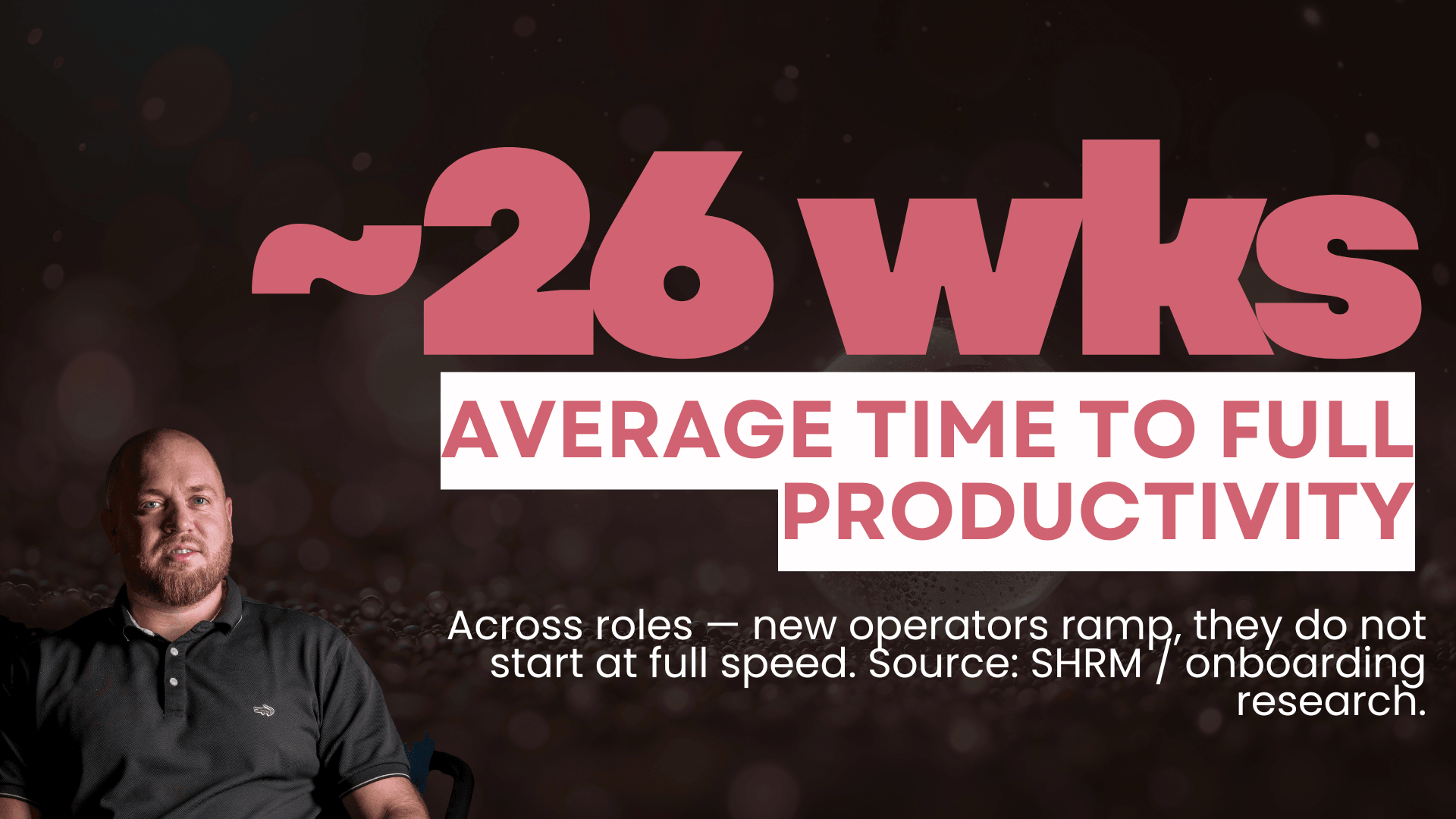
Franchisees trading sooner. Cut onboarding from six weeks to ten days — a result we have delivered — and every new franchisee starts trading around a month earlier. On a £400,000 average unit turnover at an 11.2% management fee (bfa/NatWest Franchise Survey), that pulled-forward trading is roughly £36,000 a year in royalties earned earlier across your new openings. What slow onboarding costs covers this in full.
Four weeks earlier, on every opening, adds up faster than it looks. On a £400,000-a-year unit that is around £30,000 of trading pulled forward per franchisee, and at an 11.2% fee, royalty you bank a month sooner each time you sign someone. Across a year of openings, “we onboard a bit quicker now” becomes a real line on the P&L.
Lever 4 — Reporting and decision speed: £18,000
The problems you catch in days, not months. Manual monthly reporting does not just cost the hours to produce it — it costs the weeks a dipping location drifts before anyone notices. Replace it with live data and that lag, worth around £18,000 a year on a network this size, largely disappears.
The mechanism is decision speed. Manual monthly reporting means problems surface on a five-week delay, and a dipping unit drifts the whole time. Live data collapses that delay to near zero — you intervene while it is cheap, not after it has compounded. £18,000 is a conservative read of what that lag costs a network this size in a year.
The total — and the honesty
How the £312,000 breaks down
Illustrative model for a representative 40-location, actively-recruiting network. Underlying multipliers sourced: MIT/InsideSales, Harvard Business Review, McKinsey, Asana, bfa/NatWest.
Read the caveat, not just the number
This is a model with assumed inputs — enquiry volume, franchise fee, head-office headcount. The multipliers beneath it are hard-sourced; the composite is illustrative. Change your inputs and the total moves. It is a floor, not a ceiling: McKinsey found 57% of work hours are already technically automatable, with software agents alone covering 44%. £312,000 is the conservative version.
It is worth being precise about “conservative.” McKinsey found not only that 57% of work hours are technically automatable, but that 60% of occupations have at least 30% of their tasks in that category — the exposure is broad, not niche. The £312,000 model deliberately captures a fraction of that ceiling, on four leaks that are easy to point at. The real number in your business could be lower. It could just as easily be higher.
Work hours technically automatable
57%
Software agents alone cover 44%. The ceiling is high. Source: McKinsey Global Institute, 2025.
Per location, per year
£7,800
The £312,000, spread across a 40-unit network — and most of it invisible today.
How to run this on your own numbers
You do not need us to rebuild it. Four inputs get you most of the way: how many franchise enquiries you generate a year, your average franchise fee, how many administrative or support roles your head office runs, and how long — honestly — it takes a new franchisee to start trading. Those four numbers turn this model from our illustration into your forecast.
Run them and one of two things happens. Either the leaks are smaller than the model assumes, and you have just proved your operation is tighter than most. Or they are larger — the more common result — and you have found the money before spending a penny fixing it. Both outcomes are worth an afternoon.
Where we sit in all of this
We built KORE by SOOM® to close all four leaks at once — a custom-built franchise operations and recruitment platform, not four separate tools and not someone else’s software with our name on it. Reporting, response, onboarding and admin, in one place, built for franchise networks.
See how SOOM approaches franchise marketing. The £312,000 is not the interesting number. The interesting number is how much of it is leaking out of your business right now — and how quickly you could stop it.
£312,000 is what the model says. Your own numbers will say something sharper.
Previous in this series
← Automation vs Recruitment in Franchising
← Back to the start of the series
SOOM® helps franchisors turn manual operations into systemised growth. Explore franchise marketing with SOOM →