Franchise Operations · Growth Strategy
Why Hiring More Staff Isn’t a Growth Strategy
Growing franchise networks are adding people when they should be adding infrastructure. The result is bloated head offices, rising overhead, and the same problems — just with more people attached to them.
There’s a common playbook in franchising. Network grows. Problems appear. Hire someone to fix them. Network grows more. Problems multiply. Hire again.
It’s not a strategy. It’s a reflex. And in most cases, it’s expensive, inefficient, and entirely avoidable.
The UK franchise sector has been slower than most industries to recognise this. While logistics, financial services and e-commerce have systematically replaced manual processes with automation, a large proportion of franchise networks are still adding headcount every time operations get complicated.
This article examines what that costs — in real money, lost time, and competitive position — and why the brands that will dominate by 2027 are choosing infrastructure over payroll.
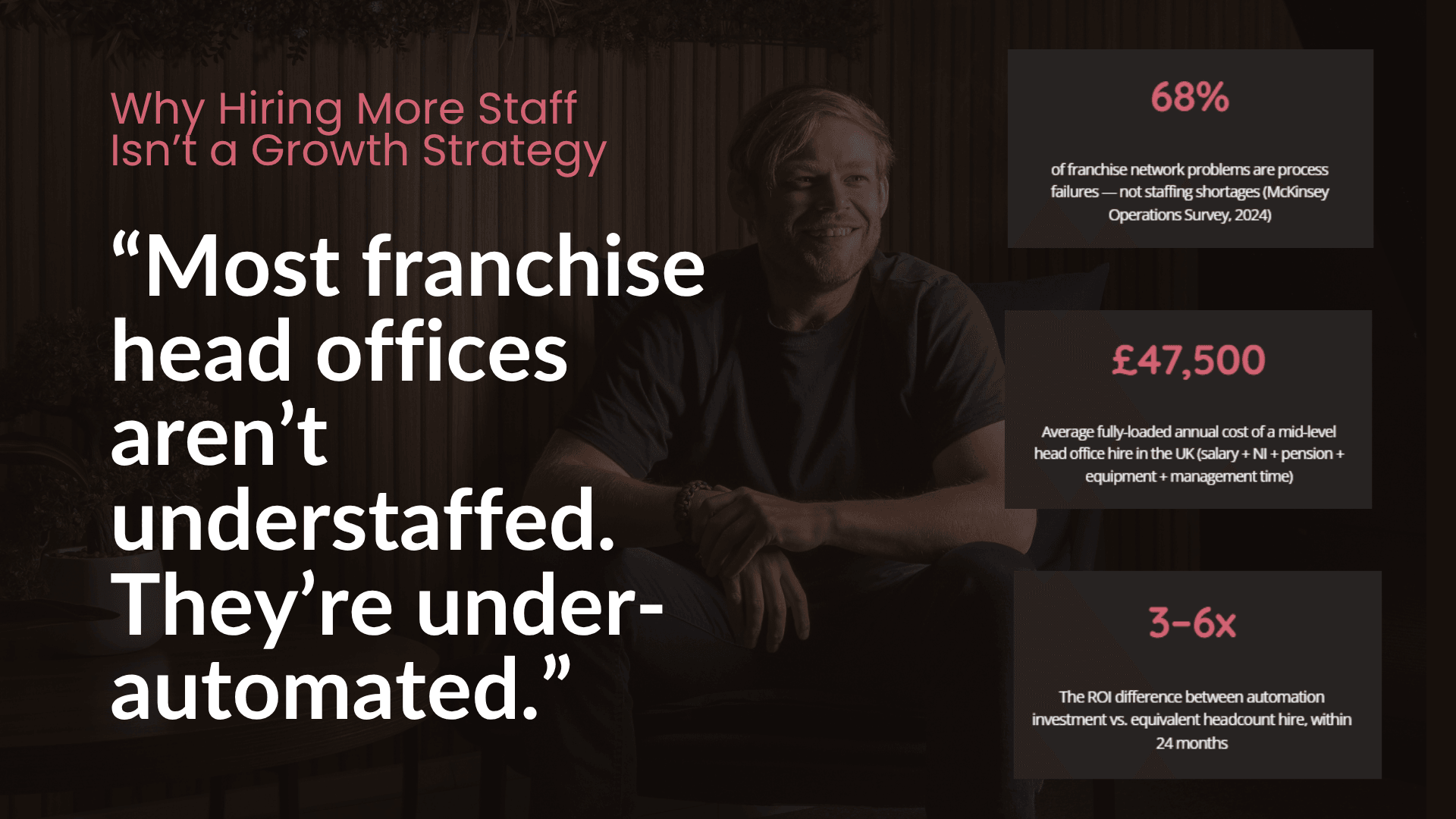
Average fully-loaded annual cost of a mid-level head office hire in the UK (salary + NI + pension + equipment + management time)
of franchise network problems are process failures — not staffing shortages (McKinsey Operations Survey, 2024)
The ROI difference between automation investment vs. equivalent headcount hire, within 24 months
The Over-Recruitment Problem at Head Office
Most franchise head offices have been built reactively. A franchisee complains about support response times — a support coordinator gets hired. Reporting becomes unmanageable — a data analyst joins. Lead volumes grow — a second recruiter is brought in.
Every one of those hires feels justified in the moment. Individually, they are. Collectively, they create a head office that’s grown horizontally rather than scaled vertically. More people doing the same work, not better systems doing more work.
The deeper issue: most of what those people spend their time on is repeatable. Data entry. Chasing updates. Formatting reports. Routing enquiries. Sending the same email seventeen times. These are not tasks that require human judgment. They require a system.
“Most franchise head offices aren’t understaffed. They’re under-automated.”
A 30-location franchise network with eight head office staff — not uncommon — could realistically reassign the equivalent of three full-time roles if standard automation were in place. That’s not a redundancy conversation. It’s a redeployment opportunity. Fewer people doing admin. More people doing the work that actually moves the needle.
When Admin Teams Grow Faster Than the Network
Below is a representative model based on typical growth patterns in UK franchise networks of 20–60 locations. It shows how head office headcount scales when process investment is absent — and what happens when automation is deployed instead.
Hire-First Model
Automation-First Model
The divergence is significant. By year four, the automation-first network is operating with roughly half the head office overhead of its hire-first counterpart — while managing the same number of locations, handling more leads, and reporting with greater accuracy.
The hire-first network isn’t underperforming. It’s just paying far more for the same output. And the cost gap compounds every year.
The Real Numbers: A 35-Location Network
Let’s put this in context with a scenario most franchise Directors will recognise.
Scenario: GreenClean Facilities — 35 Locations, 2 Years of Hire-First Growth
GreenClean is a fictional but representative UK franchise network. Two years ago, they had 22 locations and a head office team of 5. Fast growth triggered a common response: hire to cope.
+£38,000/yr
+£32,000/yr
+£14,000/yr
+£52,000/yr
+£14,600/yr
+£9,200/yr
£159,800/yr
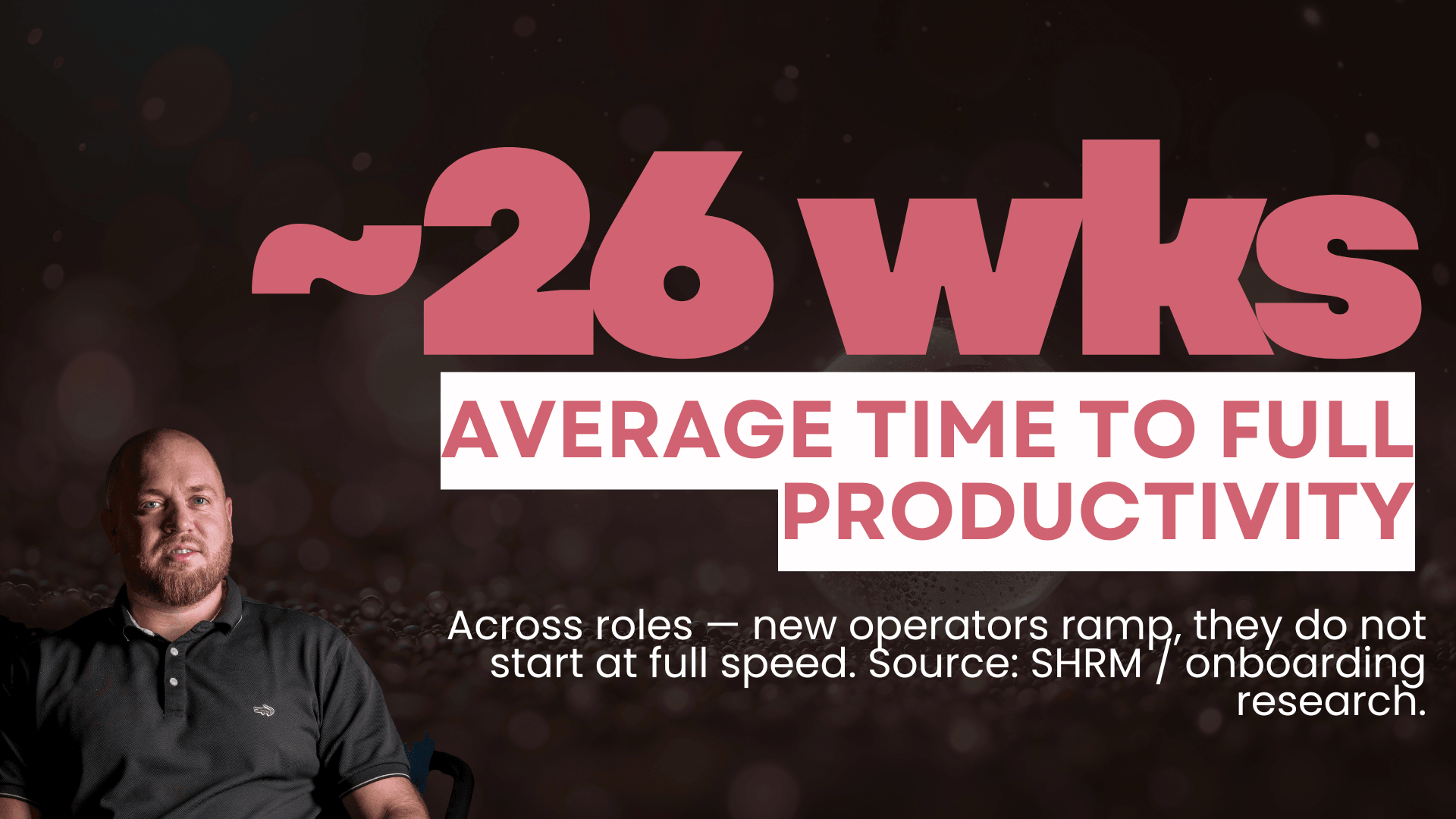
These hires resolved the symptoms. Reporting still took 3+ days per month. Lead response averaged 6.5 hours. Franchisee onboarding still ran to 8 weeks. The problems weren’t people problems. They were process problems — and adding people didn’t fix the process.
Now consider what that same £159,800 buys in automation infrastructure: a custom-built franchise operations platform with AI lead qualification, real-time KPI dashboards, automated onboarding workflows, and role-based reporting. Built once. Maintained at a fraction of ongoing payroll cost. Available 24/7. Zero sick days. Zero notice periods.
Headcount vs. Automation: A Direct Comparison
| Challenge | Hire-First Response | Automation-First Response |
|---|---|---|
| Slow lead response times | Hire a recruitment executive to manually follow up | AI caller qualifies and engages leads within 60 seconds, 24/7 |
| Monthly reporting takes too long | Hire a data analyst to collate spreadsheets | Real-time KPI dashboard — data visible to all stakeholders instantly |
| Franchisee onboarding is inconsistent | Hire a head of support to manage the process | Automated onboarding workflow — same process, every time, no exceptions |
| Compliance tracking falling behind | Add admin resource to chase and log manually | Automated compliance triggers and alerts built into operations platform |
| Head office can’t see performance at a glance | Additional management layer to aggregate and report upwards | Role-based dashboard access — head office and franchisee views separate and instant |
Why the Franchise Sector Is Behind
It’s worth being direct about this. Franchising has been slower than most industries to adopt automation — not because the technology isn’t available, but because the sector has traditionally been built on relationship-led, human-first models.
That’s not a criticism. It was the right model for a long time. But the comparison with comparable industries is now stark.
74%
68%
61%
52%
29%
Financial services, logistics and retail have spent the last decade systematically automating their operational layers — and the results show in margin improvement, scale efficiency, and headcount-to-revenue ratios. Franchising is beginning to move, but the majority of networks are still in the early stages.
The brands that move first don’t just save money. They establish a structural advantage that becomes harder to close the longer competitors wait.
“The franchise brands that will lead in 2027 aren’t the ones hiring fastest. They’re the ones building the smartest infrastructure.”
Automation Doesn’t Replace People. It Repositions Them.
The most common objection to this argument is the human one: “our franchisees need personal support, not a chatbot.” It’s a fair concern — and it misunderstands what automation actually does.
Automation handles the repeatable. Lead routing. Data capture. Report generation. Onboarding checklists. Compliance reminders. Appointment scheduling. Every hour your team spends on those tasks is an hour not spent on franchise relationship management, strategic support, and the conversations that actually retain franchisees long-term.
The argument isn’t headcount or automation. It’s headcount and automation — but in the right ratio, doing the right things.
A 40-location network does not need seven people doing the work that three could do with proper systems behind them. It needs three sharp people with full operational visibility, automated infrastructure underneath them, and the bandwidth to actually support the network they’re responsible for.
The Financial Model Most Franchise Boards Aren’t Running
When franchise leadership evaluates growth investment, hiring is typically treated as a cost of doing business. Automation is treated as a capital expenditure — and often delayed because of it.
The comparison rarely gets made on equal terms. Here it is.
10-Year Cost Comparison: 1 Mid-Level Head Office Hire vs. Equivalent Automation Platform
£47,500
£28,000
£147,200
£36,400
£254,100
£48,800
£205,300
This is a single hire comparison. Most networks in this scenario have made three to five equivalent hires over the same period. The cumulative gap is not a rounding error — it’s a strategic liability.
The Question Worth Asking
Before the next head office hire is signed off, franchise leadership teams should ask one question: is this a people problem, or a process problem?
If the honest answer is process — and in most cases it is — then the response shouldn’t be a job description. It should be a systems audit.
The networks that get this right aren’t the largest. They’re the leanest, the fastest, and the most resilient. They scale without proportionally expanding overhead. They maintain quality without adding management layers. And they respond to growth opportunities without waiting for a hire to come up to speed.
That’s not a technology pitch. It’s a competitive reality that the rest of the market is already adapting to — franchise sector included, just more slowly than most.
The brands moving now will find it very difficult to be caught.
Find out how SOOM® automates the operations
your head office is currently staffing manually.